
Releases from Correctional Training Facility
Correctional Training Facility is a CDCR state prison at Soledad Prison Road, Soledad, CA 93960. A person released from CTF is not being released from Monterey County Jail just because the prison is located in Monterey County. The release record belongs to CDCR, and the commitment county may be Monterey County or a different California county.
For current state custody, CDCR's California Incarcerated Records and Information Search, CIRIS, is the public starting point. CA.gov describes CIRIS as returning name, CDCR number, age, current location, commitment counties, admission date, and Board of Parole Hearing dates and outcomes for people currently in CDCR custody. If the person is no longer in CDCR custody, records, parole, discharge, or court channels may be needed to complete the release trail.
The CDCR release-information source below supports the state-prison path for CTF, not the county jail roster.
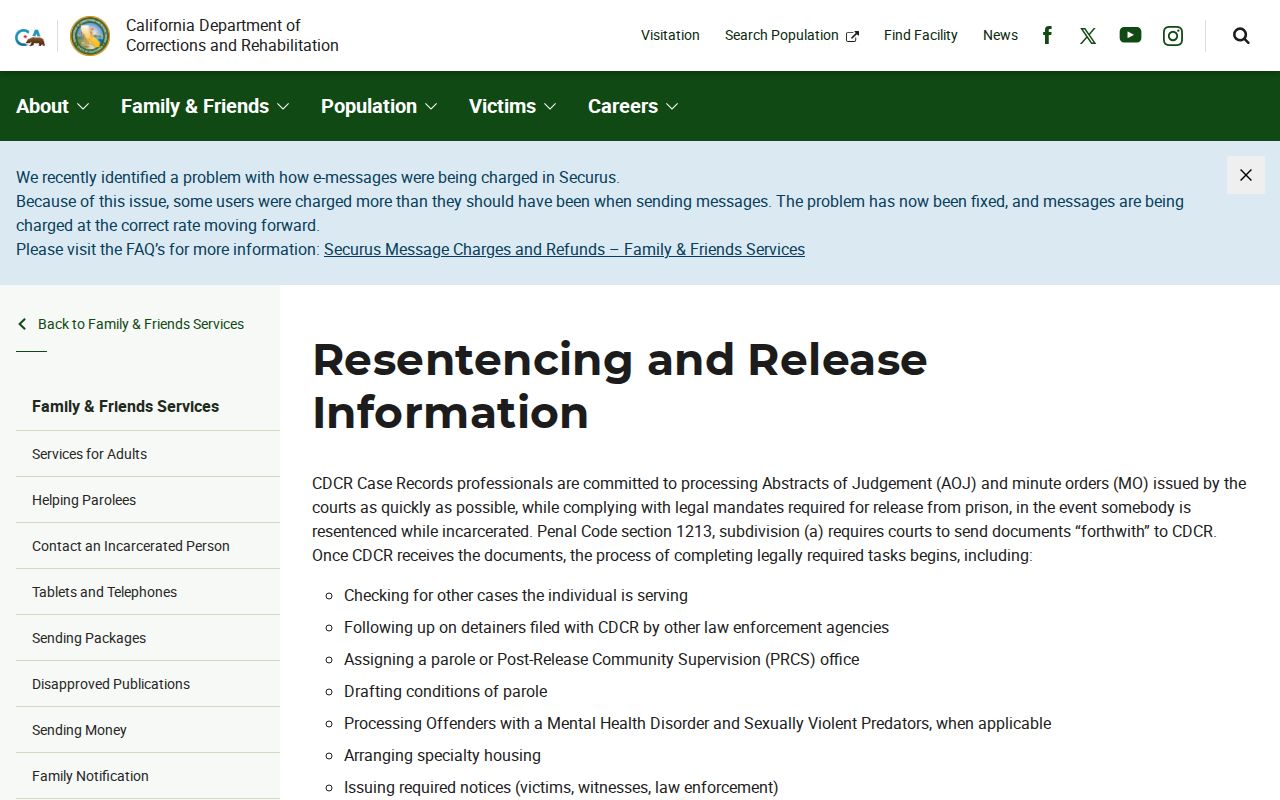
Use the image as a route marker only. The live CDCR record, the sentencing court documents, and parole or BPH records control the actual release facts.
How to Confirm a CTF Release
Start with state identifiers. A CDCR number is stronger than a name-only search because CTF houses people committed from multiple counties. If a name search is necessary, narrow results by age, commitment county, and current or last known location when the interface provides those fields.
- Search CIRIS by CDCR number or by first and last name.
- Review the record for current location, admission date, commitment counties, parole-eligible dates, and any BPH dates or outcomes shown.
- If the issue is a changed release date, use CDCR case-records and release-processing channels because credits, amended court documents, holds, and resentencing can alter a date.
- If the person was released to parole, use CDCR's Division of Adult Parole Operations. The Salinas parole unit may be relevant for Monterey County reporting, but assignment should be confirmed with CDCR.
- For life-term or suitability cases, check Board of Parole Hearings schedules and results. Use California VINE as a notification layer when the record is covered.
Correctional Training Facility Records and Contact
CDCR lists Correctional Training Facility at Soledad Prison Road, Soledad, CA 93960, with main phone (831) 678-3951. For a release-record question, identify whether the question is about current custody, release-date computation, parole status, a BPH proceeding, or the underlying sentencing case.
CDCR case-records processing is tied to court paperwork, including abstracts of judgment and minute orders. A sentencing court order may explain why the release date changed, while CDCR records explain when that order was processed and how terms and credits were applied.
About Correctional Training Facility
CTF is a state-prison facility operated by CDCR. Its release questions should be handled as state-prison questions: CIRIS for public population records, CDCR records for release processing, DAPO for parole, BPH for suitability hearing context, and California VINE for notifications where available.
| Question | Correct channel |
|---|---|
| Is the person currently in CDCR custody? | CIRIS |
| Was the person paroled from CTF? | CDCR DAPO and BPH records where applicable |
| Why did the release date change? | CDCR case records and sentencing court documents |
| Was this a Monterey County Jail release? | No, unless the person separately left county jail before or after CDCR custody |
Soledad State-Prison Distinction
Monterey County is locally unusual because two CDCR prisons sit near Soledad: Correctional Training Facility and Salinas Valley State Prison. Both are in the county, but their release paths are state-prison paths. The Monterey County Sheriff's In Custody Log is useful for local jail custody; it is not the release database for CTF.
A CTF release search should also account for the commitment county. Someone housed at CTF may have been sentenced in Monterey County, Los Angeles County, Fresno County, or another California court. The commitment county helps explain which court file holds the judgment, credits, resentencing order, or minute entry that CDCR used to compute release. That court record can be as important as the facility location when a family member or records requester is trying to understand why a release date changed.
California VINE can help when the state custody record is covered, but it should not be treated as CDCR's case-records office. VINE may send a custody-change notice, while CIRIS and CDCR records give the state-prison context. If a person is released to parole, DAPO becomes the supervision source. If a BPH suitability hearing was involved, the result may be proposed before final review, so a grant is not the same as same-day release.
CTF Release Record Package
A useful CTF release packet often has more than one source. CIRIS identifies the CDCR record and current state-custody context. The court abstract and minute orders explain the sentence that CDCR received. CDCR case records explain the credit calculation and any release processing. DAPO records explain parole after release. BPH schedules and results explain suitability matters when the sentence requires Board action.
That layered approach prevents a common Monterey County error: treating the prison address as proof that the Sheriff's Office controls the release. The Sheriff's Office can confirm Monterey County Jail custody. It cannot calculate a CTF sentence, change a CDCR release date, or verify a state parole discharge. Start with CDCR, then use the sentencing court and supervision agency that match the record.
For a determinate CDCR sentence, release timing may depend on court terms, presentence credits, postsentence credits, conduct credits, administrative credits, dead time, and any amended court documents. For an indeterminate or parole-suitability case, BPH dates and outcomes can be central, but they still need to be read with CDCR custody records. A hearing date is a process date. It is not the same as walking out of custody.
If the person is released to parole, the next record source is DAPO. The Salinas parole unit may matter when the person reports in Monterey County, but CDCR assignment should be verified rather than assumed from the prison location. If the person discharges rather than parole, CDCR records are the better source for the final custody status. If the person is transferred out before release, follow the receiving institution or agency.
California VINE can be useful for a CTF custody-change alert if the record is covered, but it is a notification layer. Save the alert and verify it against CIRIS, CDCR records, BPH results, DAPO supervision, and the court judgment. A no-match in VINE does not prove there was no CDCR custody or no release.
When the commitment county differs from Monterey County, use that court for sentence documents.
For a release to parole, compare the CDCR record with DAPO assignment details before assuming the person reports through Salinas.